

Bahaar – Handwoven Pure Tussar Banarasi
₹12,000Handwoven pure tussar with antique zari weaving Banarasi saree. Saree length 6.3 mts including blouse piece
Showing 76–90 of 562 results
Handwoven pure tussar with antique zari weaving Banarasi saree. Saree length 6.3 mts including blouse piece
Handwoven pure tussar with antique zari weaving Banarasi saree. Saree length 6.3 mts including blouse piece
GOPALPUR Natural Handspun tussar from Gopalpur weaving village of Odisha is a most unique Geographical Indication (GI). Tussar Silk grows in plenty in the wild in Odisha’s Keonjhar, Mayurbhanj and other districts. This desi Tussar silk is woven to create magical sarees!
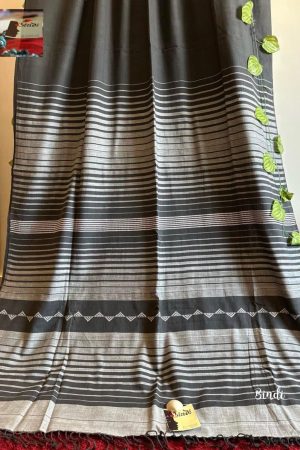
This particular saree has beautiful stripes palla and Phoda kumbha border.
Saree: Length – 6.4 metres (including blouse piece). Width – 113 centimetres.
GOPALPUR Natural Handspun tussar from Gopalpur weaving village of Odisha is a most unique Geographical Indication (GI). Tussar Silk grows in plenty in the wild in Odisha’s Keonjhar, Mayurbhanj and other districts. This desi Tussar silk is woven to create magical sarees!
This particular saree has beautiful stripes palla and Phoda kumbha border.
Saree: Length – 6.4 metres (including blouse piece). Width – 113 centimetres.
Bandhni Kanjivaram pure Silk
Saree length 6.3 mts including blouse piece
Bandhni Kanjivaram pure Silk
Saree length 6.3 mts including blouse piece
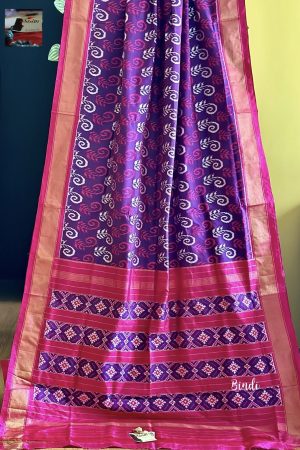
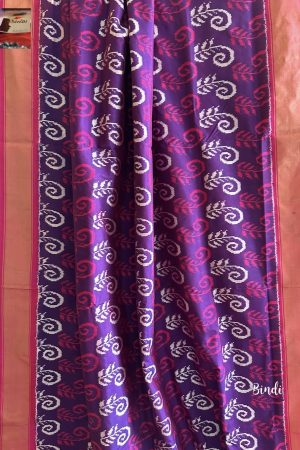
Exclusive handwoven Cambodian full body double ikkat silk saree. Crafted in Pochampally, Telangana, the Cambodian Ikat saree is inspired by the complex Cambodian Geometric Ikat patterns.
length: 6.3 mts including blouse piece
Exclusive handwoven Cambodian full body double ikkat silk saree. Crafted in Pochampally, Telangana, the Cambodian Ikat saree is inspired by the complex Cambodian Geometric Ikat patterns.
length: 6.3 mts including blouse piece
Lambadi, Labanki or Gor-boli, also called Banjari, is a language spoken by the once nomadic Banjara people across India and it belongs to Indo-Aryan group of languages. They moved to South India from Rajasthan along with the Mughal army in the 16th century and settled in Bijapur district of Karnataka.
Lambani women traditionally make embroidered handicrafts from scrap by pulling out thread from old saris and sewing together patches of cloth, which was then embellished with embroidery, mirror work, cowrie shells, beads and coins.
Today, Lambani women have put their traditional embroidery craft on the international map by adapting to the changing demands of international fashion.
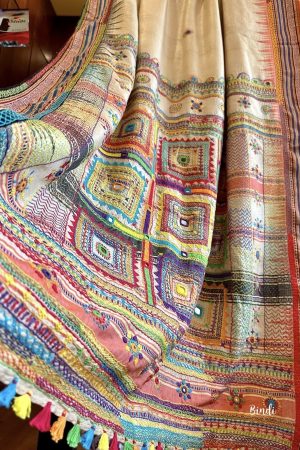
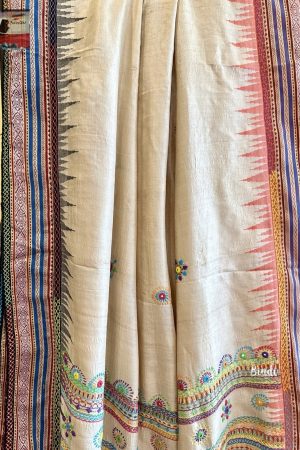
Lambani hand embroidery on premium quality Vidarbha Tussar with running blouse piece
saree length 6.3 mts
Lambadi, Labanki or Gor-boli, also called Banjari, is a language spoken by the once nomadic Banjara people across India and it belongs to Indo-Aryan group of languages. They moved to South India from Rajasthan along with the Mughal army in the 16th century and settled in Bijapur district of Karnataka.
Lambani women traditionally make embroidered handicrafts from scrap by pulling out thread from old saris and sewing together patches of cloth, which was then embellished with embroidery, mirror work, cowrie shells, beads and coins.
Today, Lambani women have put their traditional embroidery craft on the international map by adapting to the changing demands of international fashion.
Lambani hand embroidery on premium quality Vidarbha Tussar with running blouse piece
saree length 6.3 mts
Bavanbuti extra weft cotton saree from the weavers of Bihar.
Bavanbuti (fifty two) is a craft of weaving intricate Butis (Motifs) on handloom sarees. The art originated in Nalanda. It captures the beauty of the universe through motifs of Buddhist artefacts in a six yard length of Saree and is generally referred as Bavanbuti tradition. This weaving is renowned for its iconic fifty-two miniature butis (motifs) on the body of the fabric. The genesis of the word ‘Bavanbuti’ lies in the realm of mythology, folklore and tradition.
Bavanbuti extra weft cotton saree from the weavers of Bihar.
Bavanbuti (fifty two) is a craft of weaving intricate Butis (Motifs) on handloom sarees. The art originated in Nalanda. It captures the beauty of the universe through motifs of Buddhist artefacts in a six yard length of Saree and is generally referred as Bavanbuti tradition. This weaving is renowned for its iconic fifty-two miniature butis (motifs) on the body of the fabric. The genesis of the word ‘Bavanbuti’ lies in the realm of mythology, folklore and tradition.
Bavanbuti extra weft cotton saree from the weavers of Bihar.
saree length 6.25 mts including blouse piece
Bavanbuti (fifty two) is a craft of weaving intricate Butis (Motifs) on handloom sarees. The art originated in Nalanda. It captures the beauty of the universe through motifs of Buddhist artefacts in a six yard length of Saree and is generally referred as Bavanbuti tradition. This weaving is renowned for its iconic fifty-two miniature butis (motifs) on the body of the fabric. The genesis of the word ‘Bavanbuti’ lies in the realm of mythology, folklore and tradition.
Bavanbuti extra weft cotton saree from the weavers of Bihar.
saree length 6.25 mts including blouse piece
Bavanbuti (fifty two) is a craft of weaving intricate Butis (Motifs) on handloom sarees. The art originated in Nalanda. It captures the beauty of the universe through motifs of Buddhist artefacts in a six yard length of Saree and is generally referred as Bavanbuti tradition. This weaving is renowned for its iconic fifty-two miniature butis (motifs) on the body of the fabric. The genesis of the word ‘Bavanbuti’ lies in the realm of mythology, folklore and tradition.
The revival of the Begumpur weaving cluster in the recent past is one of the success stories of Indian handloom space. The result is the Begumpur sari’s new look- better in quality, colour fast, with finer yarn, one that had the all the design tradition of the classical Begumpur sarees, but with a completely wearable, contemporary feel.
End of content
End of content
Don't have an account yet? Sign up
No products in the cart.